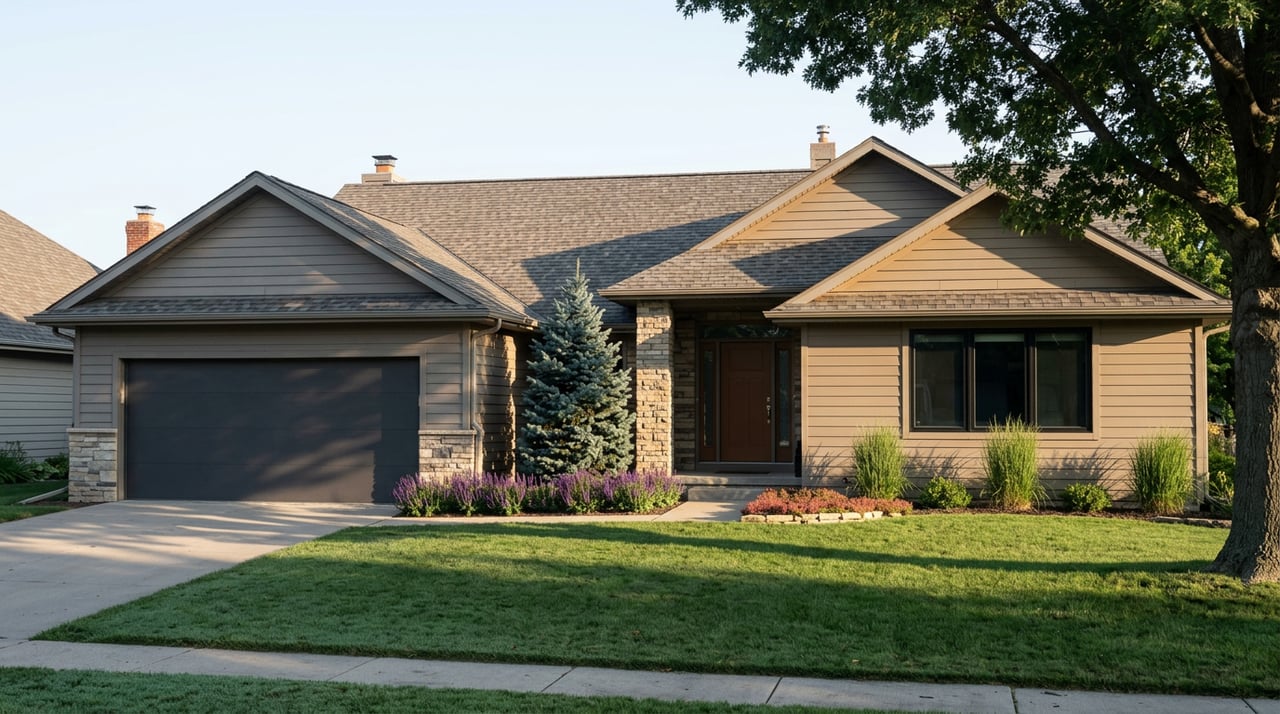
How Anthem Sold Out Is Shifting Broomfield Home Prices
September 3, 2026
September 3, 2026
A buyer comparing two nearly identical three-bedroom homes in Broomfield this summer found something that didn't make sense on paper. One listing, in a resale-only neighborhood, was priced firm with no concessions. The other, a few miles north near an active construction zone, came with a seller offering a 2/1 rate buydown and an assumable loan under 4.5 percent. Same city, same square footage, two completely different negotiations.
That gap isn't random. It traces back to a specific event: Anthem, the master-planned community that anchored north Broomfield's housing supply for nearly two decades, has sold its final home. The developer, Newland (now part of Brookfield Properties), confirmed the community had reached full build-out after 18 years, two community centers, and three distinct neighborhoods. Once a community like that finishes selling, it stops competing on builder terms. What happens next to its resale prices, and to the prices of every neighborhood still under active construction, is the actual story behind Broomfield's numbers this year.
If you've pulled up Broomfield's market data recently, you've probably noticed it contradicts itself. As of August 2026, the median list price across the city sat around $609,000, down roughly 6 percent from a year earlier. Over the same window, the median sale price for homes that actually closed, measured over the three months ending in June 2026, came in around $682,000, up about 6.2 percent year over year.
List price falling. Sale price rising. Same city, same month.
That's not a data error. It's a mix-shift. When a large share of what's closing comes from built-out, no-longer-competing-with-a-builder neighborhoods like Anthem Highlands, while a large share of what's newly listed comes from active construction corridors pricing to compete with builder incentives, the two medians can move in opposite directions without either number being wrong. The citywide figure is an average of two markets that behave nothing alike.
Anthem's build-out matters because of a pattern the mortgage industry has documented plainly: builders are aggressive with incentives while they're still selling inventory, and far less inclined to offer them once a community is finished. Rocket Mortgage's own explainer on the topic puts it simply, noting that builders are "usually less inclined to offer a buydown" once their communities are established.
That's the mechanism. While Anthem was actively selling, every resale listing nearby had to compete against a builder who could absorb a rate buydown or a closing cost credit out of a marketing budget. Now that the builder is gone, resale sellers in Anthem, and in comparably built-out communities like Broadlands, Wildgrass, and Silverleaf, are negotiating purely against each other and against scarcity. As of April 2026, Anthem Highlands carried a median price near $1,050,000, with Silverleaf close behind around $1,095,000 and Wildgrass around $987,500. Broadlands, an older golf-course community with mature landscaping, traded in the low-to-mid $700,000s to high $700,000s depending on the month measured. None of those communities have a builder down the street to undercut them anymore.
The construction that used to happen in Anthem hasn't stopped. It moved. Most of it landed in Baseline, also known as the North Park subdivision, a roughly 1,000-acre planned community in northeast Broomfield being developed by McWhinney and Realberry over the next two to four decades, with an eventual build-out of approximately 9,000 residential units.
Baseline is still very much in builder mode. Century Communities is finishing townhomes at Grand Vue at Interlocken. Lennar is building single-family and paired homes at Palisade Park, alongside Meritage Homes' energy-efficient models in the same community. DRB Homes is selling entry-level product at Dillon Pointe, with listings starting in the mid-$500,000s. David Weekley Homes has multiple active collections within Baseline itself. Even within Baseline, the active-construction status shifts village by village. West Village, one of Baseline's first neighborhoods, is already sold out. The current selling front is Parkside West, where single-family and townhomes are actively listing.
Baseline is also picking up commercial momentum that will likely keep builders motivated to sell there for a while yet. Planning documents reviewed by the regional business journal BizWest show a corner lot in the district labeled for a Whole Foods, part of the roughly 130,000 square feet of mixed-use commercial space approved for the Center Street District in the first quarter of 2026, with construction expected to begin later this year.
Here's what that active competition looks like in practice. Current resale listings near these construction zones show sellers matching builder tactics directly: a 2/1 interest rate buydown on a North Park listing, an assumable 4.25 percent FHA loan on a home near Shoshone Place, and a lender credit worth up to $10,000 on an Anthem-area townhome. These aren't builder promotions. They're resale sellers who have concluded, correctly, that they can't just list at a firm price when a builder two streets over is buying down someone's rate.
| Community | Construction status | Recent median price | As of |
|---|---|---|---|
| Anthem Highlands | Built out | ~$1,050,000 | April 2026 |
| Silverleaf | Built out | ~$1,095,000 | April 2026 |
| Wildgrass | Built out | ~$987,500 | April 2026 |
| Broadlands | Built out | ~$742,000-$798,000 | 2026 |
| Baseline / Parkside West | Active construction | From mid-$500,000s | 2026 |
The National Association of Home Builders has tracked this incentive gap nationally, reporting that more than 60 percent of builders have been offering sales incentives for over a year. Locally, the same pattern shows up in appreciation. A separate look at zip-level data through year-end 2025 found Broomfield's 80023 zip code, which covers Baseline and much of the surrounding north Broomfield growth corridor, appreciating around 9.4 percent for the year, well above the metro's roughly 1 percent overall gain, a sign that this corner of the city was already pricing differently from the rest of Broomfield before Anthem's build-out was even finished.
None of this shows up if you only look at the citywide median. It shows up when you ask a narrower question about the specific street or subdivision you're evaluating.
A seller in Anthem pricing against last year's builder-competitive comps risks underpricing a home that no longer has to compete with a builder. A seller near Baseline pricing without accounting for a neighboring builder's rate buydown risks sitting on the market while a buyer does the monthly-payment math and picks the new build instead. The broader Denver metro, spanning Adams, Arapahoe, Boulder, Broomfield, and eight other counties, posted a median closing price around $605,000 in July 2026, essentially flat month over month but up nearly 3 percent year over year. That regional number is a useful backdrop. It is not a substitute for knowing whether your specific address is competing against a builder or against nothing at all.
Does a built-out neighborhood always mean a stronger long-term investment? Not automatically. Built-out communities lose builder-driven price competition, which can support values, but they also lose new inventory, community amenities still under construction, and the ability to negotiate the kind of concessions active builders offer. Which factor matters more depends on your timeline and what you're comparing it to.
How do I find out if a builder is still active near a specific address? The clearest signal is whether a subdivision has active model homes or new listings from a builder within the same community, not just the same zip code. Baseline's own villages illustrate this. West Village is sold out while Parkside West is still selling, a distinction that matters more than the Baseline name alone.
Broomfield's price ceiling isn't set by one market anymore. It's set separately in every community depending on whether a builder is still writing checks to keep buyers coming through the door. If you're trying to figure out which side of that line your next purchase or listing falls on, Jessica Arguello at HomesBuyJess can walk through the specific comps, incentives, and construction status for your address and help you price it accordingly. Schedule a consultation before you set a number based on a citywide average that doesn't actually describe your street.
Your real estate journey is unique, and it deserves a trusted partner who understands your goals. Jessica Arguello specializes in creating a seamless experience for clients in Thornton and Denver Metro. Let’s find the home that’s right for you—your journey starts now.